-
-
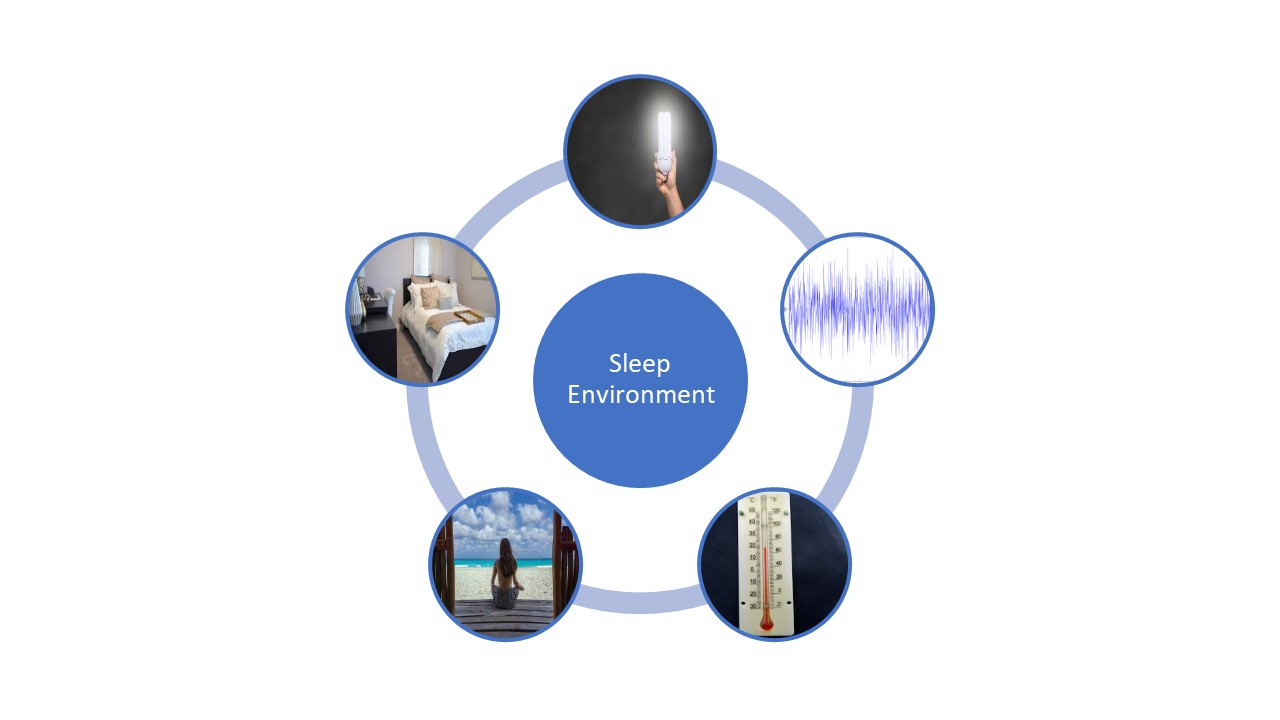
Light
 Process C, the sleep timer, depends on maximum light exposure during the day to keep you alert and minimal light exposure at night to keep you asleep. For optimal sleep, do this:
- In the morning:
- Get as much light exposure as you can after you get up in the morning.
- Take a walk in the morning sun or eat breakfast with a bright light.
- In the evening:
- Cut down on bright light in the evening an hour or two before bed-time (including reducing exposure to light from the TV, computer screen, tablets and smartphones).
- If you need to stay up a bit later for your sleep schedule, keep bright lights on to help you stay up.
How can you reduce these effects to better promote sleep?

Hallway Light:
- If light is coming in from your hallway, consider rolling a towel and placing it on the floor against your door to block the hallway light.
Outside Light:
- If light is coming in from outside, consider light blocking window treatments (either shades, if you have control over that, or curtains).
Inside Light:
- If the overhead fluorescent light is making your room too bright, work with your roommate to come up with alternative lighting options – including the use of desk lamps at night instead of the overhead light.
- Turn your alarm clock or phone (if you use it for your alarm) away from you.
- If your roommate or bed partner uses light in the evening, have an agreed upon time when the light can be turned off.
Source: Lights Out for a Good Night’s Sleep, National Sleep Foundation
Source: External Factors that Influence Sleep. Harvard Medical School Healthy Sleep
- In the morning:
-
Noise

Reducing noise will reduce middle of the night awakenings, but even noise that doesn’t awaken you can still disturb your sleep. During sleep your brain continues to detect and process sounds on a basic level.
Block out unwanted noise using a fan, ear-plugs, a white noise machine, or a smartphone white noise app. Turn off all call, text, and app notifications.
Sounds that change in tone or volume are the most disruptive to sleep. For this reason, it is NOT recommended that you fall asleep with television, music, or computer/tablet playing as these have constantly changing sound levels. Do not use any of these to cancel noise either.
Overall tips to make sure technology does not disturb your sleep
- Turn off or close your computer before bed.
- Put smartphones on silent (you can set your alarm to still go off) or use the “Do Not Disturb” function.
- Try to stop using technology 30 minutes before sleep.
- If you use your smartphone as an alarm clock, either place the phone as far away as possible, or utilize an app that darkens your screen and limits your potential to engage with your phone during sleep.
- To best promote sleep, light exposure should be maximum during the day and minimal 1-2 hours before bedtime.
- Try to set up boundaries and plan ahead. For example, before streaming movies or tv shows, think about how many you could fit in before bed-time, leaving yourself 20-30 minutes to disconnect and unwind before sleep. Without planning or setting limits, you may end up delaying your bed-time and limiting your sleep.
Source:
Environment noise and sleep disturbances: A threat to health? Sleep science
-
Temperature

In order to fall asleep, your body has to drop its core temperature. If your core temperature is too high, your body has to work to drop it, which can lead to increased arousal and more difficulty falling asleep. It is easier to lower your temperature in a cool, moderate temperature environment (i.e., around 65 degrees). If your sleep environment is too warm, it may be difficult to reduce or maintain a lower body temperature. As a result, you may have trouble falling or staying asleep.
What to do if you cannot regulate the temperature in your room?
If you cannot control the thermostat in your room, try to adjust your bedding and/or bed clothes to go with the temperature of the room. Open a window or use a small fan to circulate air throughout the room.
Sources:
-
Stress
Stress and anxiety can keep the sleep system from overtaking the wake system. To stop this, you need to quiet your mind and body. Here’s how:
How does relaxation work?
Stress and anxiety activate your nervous system. Your energy, brain activity, blood pressure, and heat rate increase. After the stressor is gone, your nervous system should wind down. Sometimes, chronic stress can keep this system active, making it difficult to sleep.
Relaxation is NOT just unwinding (e.g. watching a movie, reading) but activities eliciting physiological changes that turn off this system (decreasing brain activity, blood pressure, and heart rate) and facilitate longer and more restful sleep. The nervous system influences both the body and mind, and so relaxation activities target both as well.
What are some relaxation techniques?
There are different techniques to help you relax. Some of the most popular are:
- Guided visualization meditation
- Progressive muscle relaxation (PMR)
- Deep breathing exercises
1. Guided Visualization
- Guided visualization meditation is a relaxation technique during which you listen to an audio recording of someone talking you through a meditation.
- This is a technique that helps you imagine yourself in a different state, often one of you relaxing or engaging in a new, positive behavior.
- These are longer exercises, and you should leave approximately 15 minutes to practice.
You can Google “guided meditation” or “guided sleep relaxation” for many other examples and files for free.
2. Progressive Muscle Relaxation
- PMR can be particularly helpful when you experience muscle tension as a bodily response to stress.
- PMR involves tightening and relaxing different muscle groups in sequence.
- It helps to relieve muscle tension, which in turn helps your mind relax.
- It can also be a helpful technique to distract yourself from your worrying thoughts because you have to focus on your muscles.
- You can build PMR into your bedtime routine or you can do these exercises while lying in bed.
You can Google “progressive muscle relaxation” for many examples and files for free.
This is also a good exercise to do if you wake up in the middle of the night and have trouble getting back to sleep.
3. Deep, diaphragmatic breathing
- Deep breathing is a calming exercise that can be done on its own or along with any of the other exercises listed here. It can be done at any time to help you wind down, and can be done standing, sitting, or lying down.
- When you are stressed, your nervous system becomes activated and your breathing rate increases.
- If you pay attention, you might notice that you take many very shallow breaths from your upper lungs.
- This shallow breathing sends feedback to the rest of your body that you are stressed, which maintains the rapid, shallow breathing.
- Paying attention to your breath and consciously slowing down your breathing rate is an effective way to help you reduce both mental and physical stress.
- Deep, diaphragmatic breathing slows down your respiration rate, increases the amount of oxygen you are taking in with each breath, and reduces the effort and energy your body is using to breath.
To learn this technique and maximize its effectiveness, practice for at least 5 minutes a few times per day. You can use this technique lying down to help you fall asleep or if you wake up in the middle of the night.
Sources:
- Stress and Insomnia, National Sleep Foundation
- Three Signs You’re Too Stressed to Sleep-and How to Unwind, National Sleep Foundation
- The effect of psychological stress on sleep: a review of polysomnographic evidence, Behavioral sleep medicine
- External Factors that Influence Sleep, Harvard Medical School Healthy Sleep
-
Comfort

You want your bed/bedroom to trigger cues for sleep. The best way to accomplish this is to use the bedroom for nothing except sleeping and sexual activity. But many young adults have limited living space and so use their bedroom for other things as well including work, reading, watching TV, and eating.
Ideally do these things somewhere else than your bed like a desk. If you must use your bed, then do them sitting up at the foot of your bed, on top of your bedding.
Minimize clutter in your bedroom and bed. If you have to keep things on or around your bed, consider taking some time here and there to straighten them up. Make sure nothing impacts your ability to get comfortable when you are trying to sleep, or gets in your way if you need to get out of bed. Make sure you have a comfortable pillow and mattress. You can also use a pad if the mattress is not comfortable.
You want your body to understand that when it is in bed, it is time to sleep.
Source: External Factors that Influence Sleep. (n.d.). Retrieved from http://healthysleep.med.harvard.edu/healthy/science/how/external-factors
Pain

Unmanaged pain (including back pain, headaches, jaw/facial pain, and musculoskeletal pain) makes it tough to fall and stay asleep. In particular, pain can cause “microarousals” (a change in sleep from a deeper phase to a lighter phase) and increase night awakenings.
Better sleep hygiene in all the other areas we have discussed today can mitigate the impact of pain. It this does not solve the problem, consult your primary care physician for treatment recommendations and evaluation.
Source: External Factors that Influence Sleep. (n.d.). Retrieved from http://healthysleep.med.harvard.edu/healthy/science/how/external-factors
-
Consider Your Sleep Environment

